Most first-time visitors arrive with questions they did not feel comfortable asking the receptionist. How long will it take? Will there be needles today? What should you wear? A TCM consultation in Singapore at a properly registered clinic follows a clear structure, and knowing it ahead of time changes how much you get out of the visit. This blog will walk you through every step, from booking to follow-up, drawing on howour TCM practice at GI Life Sciences runs first sessions.
Before You Walk In
A first TCM appointment is not a quick drop-in. Treat it more like a new patient consultation with a doctor than a 15-minute reflexology slot. The preparation matters because the diagnostic methods used in TCM rely on signals that everyday activities can mask.
Booking and what to mention upfront
When you call or book online, mention your main concern in one sentence, any current medications and supplements, whether you are currently menstruating (if relevant), and any recent infections or surgeries. Good clinics use this to allocate enough time. At our Ubi Road clinic, a first session runs 45 to 60 minutes, which is the realistic time required for a thorough four-method diagnostic process plus initial treatment. Shorter slots are usually a follow-up format.
Things to avoid in the hours before
Brush your teeth normally but skip the heavily coloured drinks for two hours before the visit. Black coffee, red wine, beetroot juice, and strong tea all stain the tongue coating, which is one of the primary diagnostic signals. Light meals are fine, large meals or fasting both distort the pulse picture. Wear loose clothing that allows access to the forearms (for pulse reading) and ideally the legs and abdomen (for acupuncture if needed). Heavy perfume, lipstick, and tongue scrapers can also obscure findings.
Bring your medical context
Bring a list of current medications, recent blood test results if you have any from the last six months, and a brief history of when symptoms started. Photos of skin conditions or unusual physical signs from earlier in the week are useful because the picture often shifts day to day. A licensed TCM practitioner is trained to integrate this information rather than ignore it.
What Happens During the Consultation
A first TCM consultation in Singapore follows the four-method diagnostic framework called si zhen (四诊). Practitioners structure the session around these four channels of information, then synthesise findings into a pattern diagnosis that guides treatment.
Inspection (wang 望)
The practitioner observes you from the moment you walk in. Posture, skin tone, energy level, the brightness of the eyes, the way you breathe, and how you move all contribute. The most distinctive part of this stage is the tongue inspection, where you stick your tongue out fully (relaxed, not pointed) for about five to ten seconds. The practitioner looks at body colour (pale, normal, red, purple, dark), shape (thin, swollen, scalloped, cracked), coating (thin, thick, white, yellow, greasy, peeled), and moisture. Each combination maps to specific patterns. A red tongue with thick yellow coating points toward damp-heat. A pale, swollen tongue with teeth marks points toward spleen qi deficiency. According to the National Heritage Board’s reference on Singapore TCM, TCM views the body as an organic whole where the five core zang organs and six fu organs are linked via meridians that carry qi, blood, and information between different parts of the body, which is why a single tongue observation can carry information about multiple internal systems.
Inquiry (wen 问)
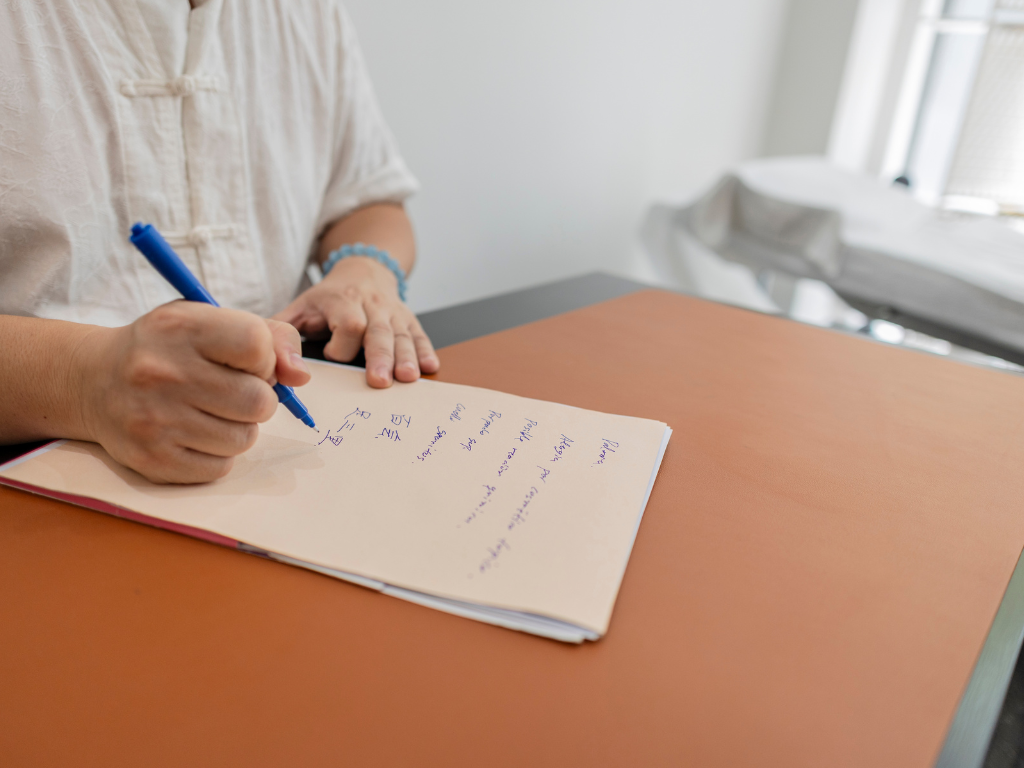
The longest section of a first consultation is the inquiry phase, typically 20 to 30 minutes. The questions go beyond what most biomedical consultations cover. Sleep timing in detail (when you fall asleep, when you wake, whether you wake at specific hours), bowel patterns (frequency, form, completeness), urination (colour, frequency, urgency), sweating (when, where, how much), thirst and food preferences (cold versus warm drinks, particular cravings or aversions), menstrual cycle quality if applicable, emotional patterns over the past few months, and how energy distributes across the day.This level of inquiry is not interrogation. It builds a multi-system picture that no single biomarker can produce. Honest answers matter here, even on questions that feel unrelated to your main concern. Our piece onwhy daily wellness signals often matter more than annual screenings explains why this kind of detailed observation often surfaces issues months before they show up in standard tests.
Listening and smelling (wen 闻)
The practitioner listens to your voice, your breathing pattern, any cough or wheeze, and the rhythm of your speech. Body odour and breath quality also contribute. Most patients do not notice this stage as a separate step because it happens during the inquiry phase.
Palpation (qie 切)
Pulse reading is the final and most technically demanding part of the diagnostic process. You rest your wrist palm-up on a small cushion, and the practitioner places three fingers along the radial artery at the wrist. Pulse is read at three positions on each wrist (cun, guan, chi) and at three depths (superficial, middle, deep). The practitioner looks for qualities like floating, sinking, wiry, slippery, thin, rapid, slow, or empty.This usually takes 60 to 90 seconds per wrist. A skilled practitioner can read 28 distinct pulse qualities, though most diagnostic decisions rely on a smaller set of common ones. Palpation can also extend to specific acupuncture points or areas of the abdomen if the case calls for it.
The Diagnostic Synthesis
After the four-method gathering, the practitioner connects the findings into a pattern diagnosis. This is the most important part of the consultation, and where the work of a licensed TCM practitioner separates from a herbal shop assistant.
Constitution and pattern identification
TCM constitution types and disease patterns are different things, though they interact. Constitution describes your baseline tendency (yang excess, qi deficient, damp, blood stasis, yin deficient, and others). Pattern describes the current imbalance driving symptoms. A yang excess constitution with current damp-heat in the liver presents differently from a qi-deficient constitution with current damp-heat in the spleen, even if symptoms look similar at a surface level.The practitioner explains the pattern in plain language at the end of the consultation. If the explanation is vague or the practitioner cannot tell you what your pattern is and why, that is a flag worth noticing.
Where the ESG metabolic assessment fits
At GI Life Sciences, complex cases often include our ESG metabolic energy assessment, a non-invasive measurement we introduced in 2008 that maps which body systems are running outside their functional range. It does not replace the four-method TCM diagnosis, but adds an additional layer of data on energy distribution across organ systems. For straightforward presentations this is not always needed at the first visit.
What Treatment Looks Like on the First Visit
Most first consultations include some initial treatment, but not always the full plan. The structure depends on what the diagnosis reveals.
Acupuncture session walkthrough
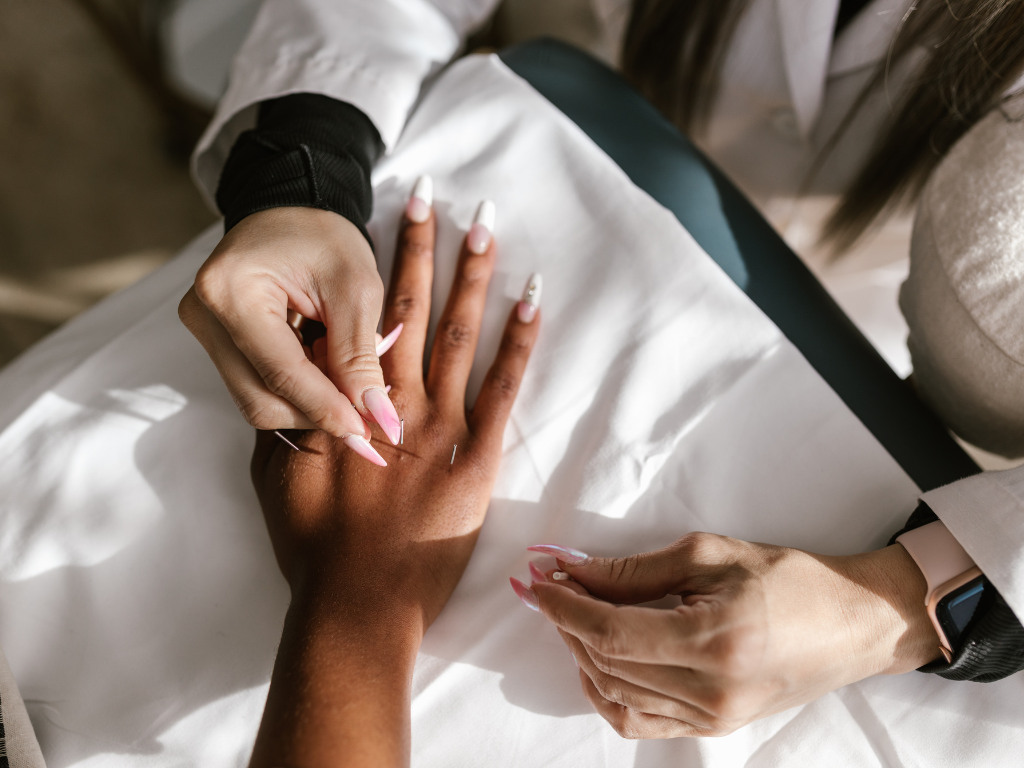
If acupuncture is appropriate and you consent, the practitioner selects 6 to 12 points (or more) based on your pattern. Sterile single-use needles (regulated under Singapore’s Health Sciences Authority for class A medical devices) are inserted to depths between 5 and 25 millimetres depending on the point. Most patients describe the sensation as a brief prick followed by a dull, heavy, or radiating feeling called de qi. Needles stay in for 20 to 30 minutes (or longer if time allowed) while you rest, usually on a treatment bed in a quiet room. Our walkthrough ofhow acupuncture therapy fits into wider treatment programmes covers what longer protocols typically look like.
Herbal prescription process
If herbs are prescribed, the practitioner explains the formula, expected effects, and any short-term sensations to expect (mild loosening of stools, temporary increase in urination, slight changes in sleep). Singapore-licensed Chinese Proprietary Medicines are regulated by the Health Sciences Authority, which requires product listing approval before any CPM can be sold or dispensed. Herbal formulas may be granules, capsules, or raw herbs, depending on the case and your willingness to brew at home.
Lifestyle and dietary recommendations
A practitioner who only prescribes treatment without addressing lifestyle is doing half the job. Expect concrete recommendations on sleep timing, what to reduce in the diet (often refined sugars, fried foods, or cold raw foods depending on pattern), and what to add (warming foods, specific teas, or fermented options). These take time to take effect, but they shape the trajectory more than any single session. The principles in our piece on why consistent daily habits outperform intensive bursts apply directly here.
After the First Visit
A clear next step is part of any well-run first TCM consultation in Singapore. You should leave knowing your pattern diagnosis, the recommended treatment frequency, the cost structure for follow-ups, and what to monitor between visits.For most chronic presentations, weekly acupuncture sessions for the first month then every two weeks is the typical structure. Herbal formulas are reviewed every two to four weeks because the pattern shifts as the body responds, and a static prescription stops being optimal once that happens.Verify your practitioner’s registration. The Traditional Chinese Medicine Practitioners Board, operating under the Ministry of Health, maintains a public register of TCM physicians and acupuncturists in Singapore, and any practitioner can be checked by name. A current practising certificate must be displayed at the place of practice, and you are welcome to ask to see it. At GI Life Sciences, our clinical lead Tay Swee How holds a TCMPB practising certificate .
Conclusion
A first TCM consultation in Singapore works best when you treat it as a real medical visit rather than a wellness drop-in. Preparation, honest inquiry answers, and a clear understanding of the diagnostic structure produce the most accurate pattern read and the most useful treatment plan. The goal of the first session is to give you a coherent picture of what is happening and a realistic plan for what comes next.If you want to start with a properly structured first consultation that runs the full four-method process and produces a written assessment,book an appointment with our licensed TCM practitioner. The first session takes an hour and gives you a real diagnostic baseline to work from, whether or not you continue treatment afterward.
Frequently Asked Questions
How long does a first TCM consultation in Singapore usually take?
A proper first consultation runs 45 to 60 minutes, covering the four-method diagnostic process (inspection, inquiry, listening and smelling, palpation), pattern identification, and initial treatment if appropriate. At GI Life Sciences, the first session also delivers a written assessment summarising the diagnosis and recommended treatment frequency.
Will I receive acupuncture on my first visit?
Often yes, but not always. If the diagnosis points clearly to a pattern that acupuncture addresses well and you consent, the practitioner selects 6 to 12 (or more) points and inserts sterile single-use needles for 20 to 30 minutes (or longer if time allowed). Some first consultations focus entirely on diagnostic work and lifestyle recommendations, with treatment beginning at session two.
How do I check if a TCM practitioner in Singapore is registered?
Search the public register maintained by the Traditional Chinese Medicine Practitioners Board (TCMPB), a statutory board under the Ministry of Health. You can search by name, registration number, or place of practice. A current practising certificate must be displayed at the clinic. Any registered TCM practitioner should welcome this verification.
What should I avoid before my first TCM consultation?
Skip strongly coloured drinks (coffee, tea, red wine, beetroot juice) for two hours before the visit because they stain the tongue coating, which is a key diagnostic signal. Avoid heavy meals immediately before and avoid going in fasting. Brush teeth normally but do not scrape the tongue. Wear loose clothing that allows wrist and forearm access.
Will I need to take Chinese herbal medicine after the consultation?
Not necessarily. Some patterns respond well to acupuncture and lifestyle changes alone. Others benefit from a herbal formula adjusted to your specific pattern. Any prescribed Chinese Proprietary Medicines in Singapore must hold a Health Sciences Authority product listing. Your practitioner should explain expected effects and any short-term sensations before you start.