Chronic inflammation rarely shows up as one clean complaint. It hides inside persistent fatigue, recurring digestive issues, joint stiffness, and skin problems that never quite resolve. TCM for inflammation in Singapore is a different diagnostic system, not a foreign vocabulary stapled onto biomedical care. This blog will walk you through howa licensed TCM consultation actually reads these patterns and what treatment looks like in practice.
Why TCM Reads Inflammation Differently
Western medicine identifies inflammation by elevated cytokines, raised C-reactive protein, and a named pathological process attached to a named organ or system. Once a label is fixed, treatment follows the label. Traditional Chinese Medicine works in reverse. The practitioner builds a picture of the patient’s whole pattern first, then assigns treatment to that pattern, not to the disease name.This is called bian zheng lun zhi (辨证论治), pattern differentiation to determine treatment. Two patients with the same biomedical diagnosis, say eczema, can present completely different TCM patterns and receive completely different treatments. One might show excess heat in the lungs while the other shows damp-heat in the spleen and stomach. Conversely, a single TCM pattern, like damp-heat, can underlie eczema, chronic sinusitis, irritable bowel symptoms, and recurrent urinary tract infections in different patients. The thread connecting them is the underlying physiological imbalance, not the named disease.What TCM calls “heat” is not a temperature claim. It is a functional descriptor. Practitioners use it to mean a state where the body is producing too much activity in a particular system, exhausting fluids, and generating signs that map closely onto what biomedical research now describes as low-grade inflammation. A 2025 review in Advanced Chinese Medicine documented how many TCM herbs and formulas exert their effects by modulating the NLRP3 inflammasome pathway, TLR4/NF-κB signalling, and other validated inflammatory cascades. The vocabulary differs from biomedical writing, but the underlying biology lines up in clear ways.
The Patterns Behind Chronic Inflammation in TCM
Most chronic inflammatory presentations in our Singapore clinic fall into four common patterns. Adults often carry more than one at the same time.
Excess heat (实热)
This is the textbook hot pattern. Tongue body is red, often with a yellow coating. The pulse runs rapid and forceful. People with this pattern tend to feel hot easily, prefer cold drinks, get constipated, have a dry mouth, and sometimes react to small irritations with disproportionate anger. Acne with red, inflamed lesions, and the kind of flare-up rashes that look angry rather than weepy usually sit in this category.
Damp-heat (湿热)
Singapore’s climate makes this the single most common inflammatory pattern we see at the clinic. Humidity stays high year round, and the standard hawker diet adds frequent fried, sweet, and dairy-heavy foods that the body struggles to clear. The tongue shows a thick, yellow, greasy coating. The pulse runs slippery and rapid. Patients describe oily skin, sticky or sluggish stools, persistent fatigue that does not improve with rest, a bitter taste in the morning, and a general sense of feeling weighed down. Damp-heat in the liver and gallbladder system is closely tied to recurrent skin issues and irritability. Damp-heat in the spleen and stomach drives digestive inflammation and chronic loose stools.
Qi stagnation transforming into heat (气郁化火)
This is the working professional’s pattern. Sustained stress causes liver qi to stagnate, which over months or years generates internal heat. The tongue shows red edges. The pulse is wiry, almost taut under the fingers. Symptoms include irritability, chest or rib tightness, sighing, premenstrual breast tenderness, tension headaches that worsen with stress, and a sleep pattern where you fall asleep fine but wake at 1 to 3 a.m. and cannot get back down.
Yin deficiency with empty heat (阴虚火旺)
This pattern usually develops after prolonged inflammation has depleted the body’s cooling substances. The tongue body is red with a thin or peeled coating. The pulse is thin and rapid. Patients describe night sweats, dry mouth at night, hot palms and soles, low-grade restlessness, and sleep that feels light and unrefreshing. We see this often in clients who have been running on stress for years before they finally seek help.
How a Practitioner Diagnoses These Patterns
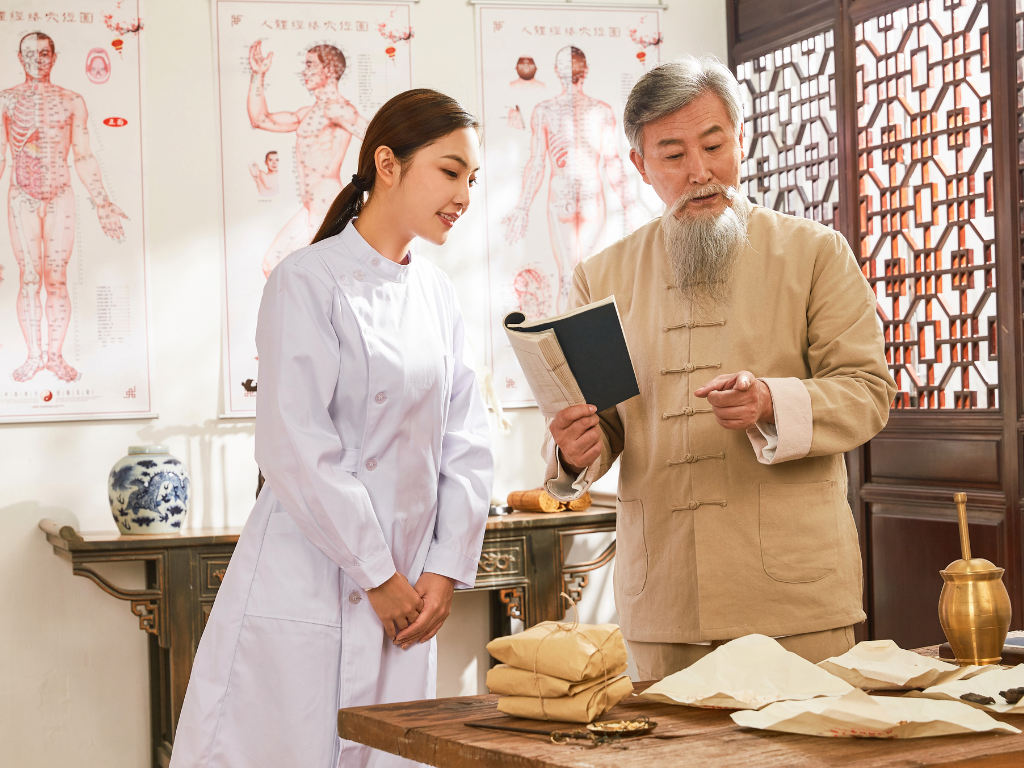
TCM diagnosis uses four methods, known as si zhen (四诊). Inspection (wang 望), listening and smelling (wen 闻), inquiry (wen 问), and palpation including pulse reading (qie 切). The data sources are different from biomedical examination, but the rigour required is similar.Tongue inspection is the most distinctive. A practitioner looks at body colour (pale, normal, red, dark), shape (thin, swollen, scalloped at the edges), coating (thin, thick, yellow, white, greasy, peeled), and moisture. Each combination points toward specific patterns. Pulse reading uses three positions on each wrist, examined at three depths, looking for qualities like wiry, slippery, thin, rapid, deep, or floating. With practice, the pulse gives information about which organ systems are out of balance.The inquiry phase asks questions most biomedical consultations skip. Sleep timing matters specifically. Waking between 1 and 3 a.m. flags liver heat. Waking between 3 and 5 a.m. flags lung issues. We ask about bowel patterns in detail, menstrual cycle quality, sweating patterns, taste in the mouth, body temperature preferences, and which times of day energy peaks or crashes. The point is not to fish for matches. It is to build a coherent picture across multiple body systems that often surface the same imbalance from different angles. Our piece on reading the body’s signals covers some of these markers in lay terms.A first TCM consultation at our clinic usually runs 45 to 60 minutes, which is the time it actually takes to gather this picture well.
What TCM Treatment Looks Like in Practice
Acupuncture point selection
Pattern-based selection means the point combination changes with the diagnosis, not with the disease name. For excess heat patterns, practitioners typically include LI11 (Qu Chi) and LI4 (He Gu) for general heat clearing, plus DU14 (Da Zhui) for systemic heat. For damp-heat in the spleen and stomach, SP9 (Yin Ling Quan) and ST40 (Feng Long) help resolve dampness, paired with heat-clearing points. For qi stagnation, LR3 (Tai Chong) opens stuck liver qi. The same client might receive a different combination at session two if the tongue and pulse have shifted. This is one of the practical reasons why a course of acupuncture therapy is structured as a series rather than a one-off appointment.
Herbal formulations
TCM herbal medicine works from classical base formulas, modified for the individual. Long Dan Xie Gan Tang (Gentian Liver Drainer) is the standard starting point for damp-heat in the liver and gallbladder system. Yin Chen Hao Tang clears damp-heat affecting the digestive system. Zhi Zi Chi Tang addresses heat causing irritability and sleep disturbance. A practitioner rarely prescribes the unmodified textbook formula. Adjustments account for the specific constitution, season, and current symptom pattern. A 2022 systematic review in Frontiers in Cardiovascular Medicine of 38 randomised controlled trials involving over 4,000 participants found that Chinese herbal medicine reduced inflammatory biomarkers relevant to cardiovascular disease risk, particularly when used alongside standard anti-inflammatory care.In Singapore, all Chinese Proprietary Medicines are regulated by the Health Sciences Authority, which requires product listing approval before any CPM can be imported, manufactured, or sold. This is one of the trust signals worth checking when sourcing herbs.
Dietary therapy
TCM dietary therapy, called yao shan (药膳), uses food as the long-arc complement to herbal treatment. For damp-heat patterns common in Singapore, that usually means reducing fried foods, sweetened drinks, dairy, and refined carbohydrates, while adding mung bean, barley, winter melon, bitter melon, and chrysanthemum tea. For yin deficiency, more sour and slightly cooling foods help, like pear, black sesame, and lily bulb. Our article onwhy food diversity matters more than restrictive eating covers the everyday principles.
Lifestyle alignment
Sleep before 11 p.m. matters more in TCM than most patients expect. The hours from 11 p.m. to 3 a.m. are when the liver and gallbladder systems do their primary work in the classical framework. Staying up consistently past midnight depletes these systems over years, which is one of the most common contributors to the qi-stagnation-into-heat pattern in Singapore professionals. Reducing emotional reactivity and pacing exertion to constitution also play a part. A small daily practice held for months tends to outperform an intensive intervention done once.
How TCM Fits Alongside Biomedical Care in Singapore
The Traditional Chinese Medicine Practitioners Board (TCMPB), a statutory board under the Ministry of Health, has regulated TCM practice in Singapore since the Traditional Chinese Medicine Practitioners Act 2000 came into force. Every practising TCM physician and acupuncturist must hold a valid practising certificate, displayed at their place of practice. The Board accredits the local TCM schools, regulates professional conduct, and maintains the public register where anyone can verify a practitioner’s status.This is the framework GI Life Sciences has worked. Our clinical lead, Tay Swee How, is a licensed TCM practitioner, and the Ubi Road clinic operates as a registered place of practice. We are not positioning TCM as a replacement for biomedical care. The most useful framing for chronic inflammation cases is that biomedical investigation tells you what is happening at the tissue and biomarker level, while TCM diagnosis tells you what underlying functional pattern keeps producing it. Both layers of information change what treatment makes sense.
Conclusion
Chronic inflammation in TCM is rarely treated by chasing the symptom. It is treated by identifying which underlying pattern keeps the inflammatory state going, then methodically addressing that pattern through acupuncture, herbs, food, and lifestyle alignment over several months. Patients who commit to a full course usually see steady improvement rather than dramatic short-term reversals, and the changes tend to hold.If you have been managing inflammatory symptoms that never quite resolve and want a TCM read on what is actually driving them,book a consultation with our licensed practitioner. The first session takes about an hour and produces a clear written assessment of your pattern and recommended treatment plan.
Frequently Asked Questions
Is TCM treatment for inflammation evidence-based?
For specific applications, yes. A 2022 systematic review of 38 randomised controlled trials found that Chinese herbal medicine measurably reduced inflammatory biomarkers including hs-CRP and IL-6. Acupuncture has documented effects on autonomic regulation and cytokine levels. The evidence base is stronger for some conditions than others, and a licensed TCM practitioner in Singapore should be willing to discuss what is and is not well supported.
How long does TCM treatment for chronic inflammation usually take?
Most chronic inflammatory patterns at GI Life Sciences are treated over 8 to 16 weeks. Acupuncture is typically weekly for the first month, then every two weeks. Herbal formulas are reviewed every two to four weeks because the pattern shifts as the body responds. Sustained changes in tongue, pulse, and symptoms usually appear by week six in most patients.
How is a Singapore-registered TCM practitioner different from a herbal shop seller?
A registered TCM physician holds a practising certificate from the Traditional Chinese Medicine Practitioners Board under the Ministry of Health, governed by the TCM Practitioners Act 2000. This requires accredited academic training, supervised practice, qualifying examination, and ongoing continuing professional education. A herbal shop salesperson without TCMPB registration cannot legally diagnose or prescribe.
Can I do TCM treatment while taking Western medication?
In most cases, yes, but it needs to be coordinated. Some Chinese herbs interact meaningfully with blood thinners, blood pressure medication, and certain immunosuppressants. A licensed TCM practitioner should ask for your full medication list at the first visit and adjust formulas accordingly. We routinely work with clients who are also under specialist or GP care.
What does a first TCM appointment for inflammation involve?
A 45 to 60 minute consultation including detailed health history, tongue inspection, pulse reading, and discussion of sleep, digestion, energy, and stress patterns. The practitioner identifies your dominant TCM pattern and outlines a treatment plan that may include acupuncture, herbal medicine, dietary adjustments, and lifestyle recommendations specific to your constitution.